Objects and inscriptions
Hezekiah's tunnel and the Siloam inscription (Jerusalem, found 1880)
A rock-cut water tunnel under the City of David ends near a Hebrew inscription describing two crews meeting underground. Dating places it around 700 BCE, consistent with the conduit 2 Kings 20:20 and 2 Chronicles 32:30 credit to Hezekiah. The inscription itself names no king.
Also in: Places
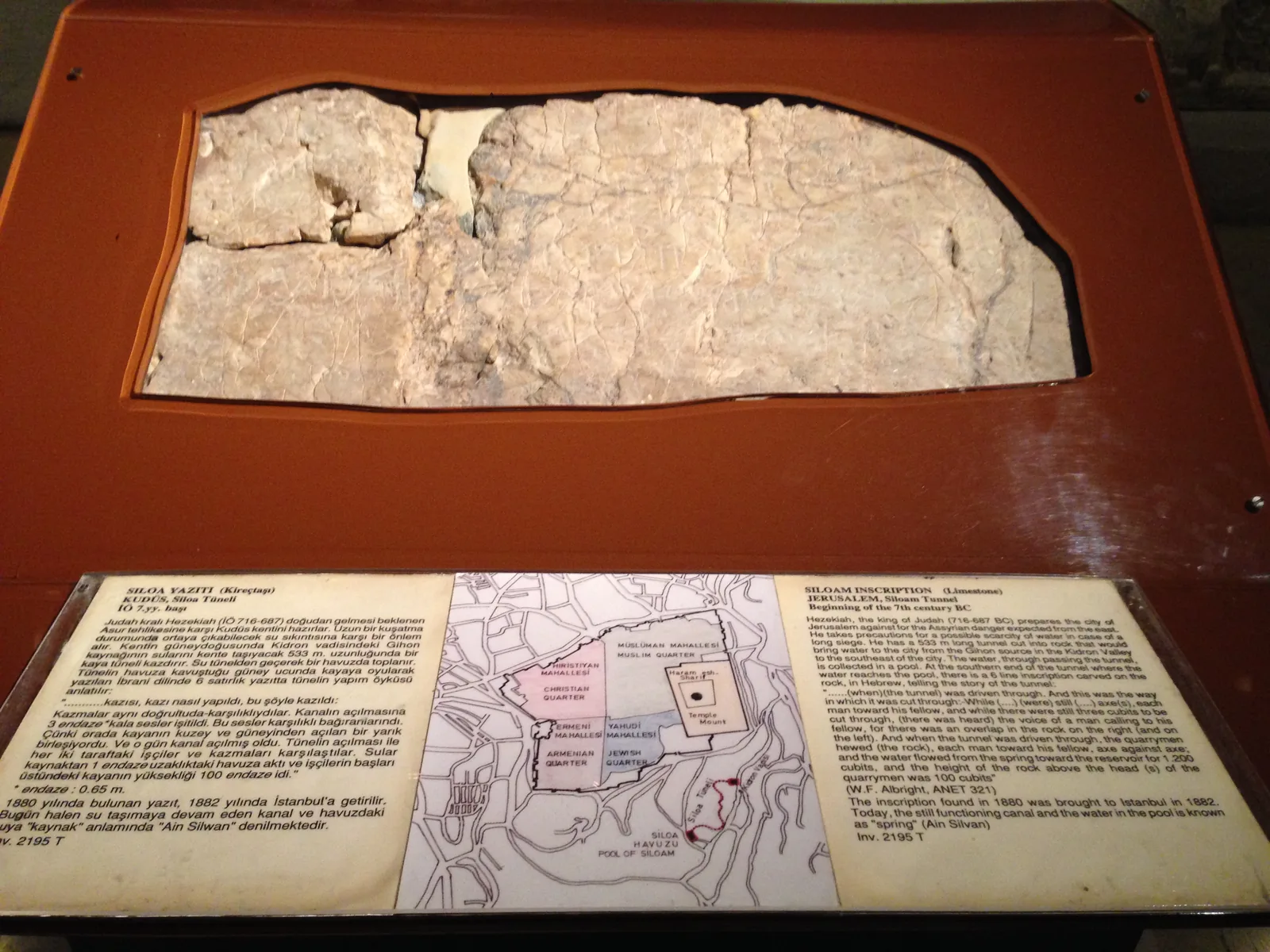
The Siloam inscription (original), as displayed at the Istanbul Archaeological Museums. A copy stands in the tunnel itself. The inscription records the meeting of the two teams who cut the tunnel.
Photo: oncenawhile, via Wikimedia Commons, CC0 1.0.

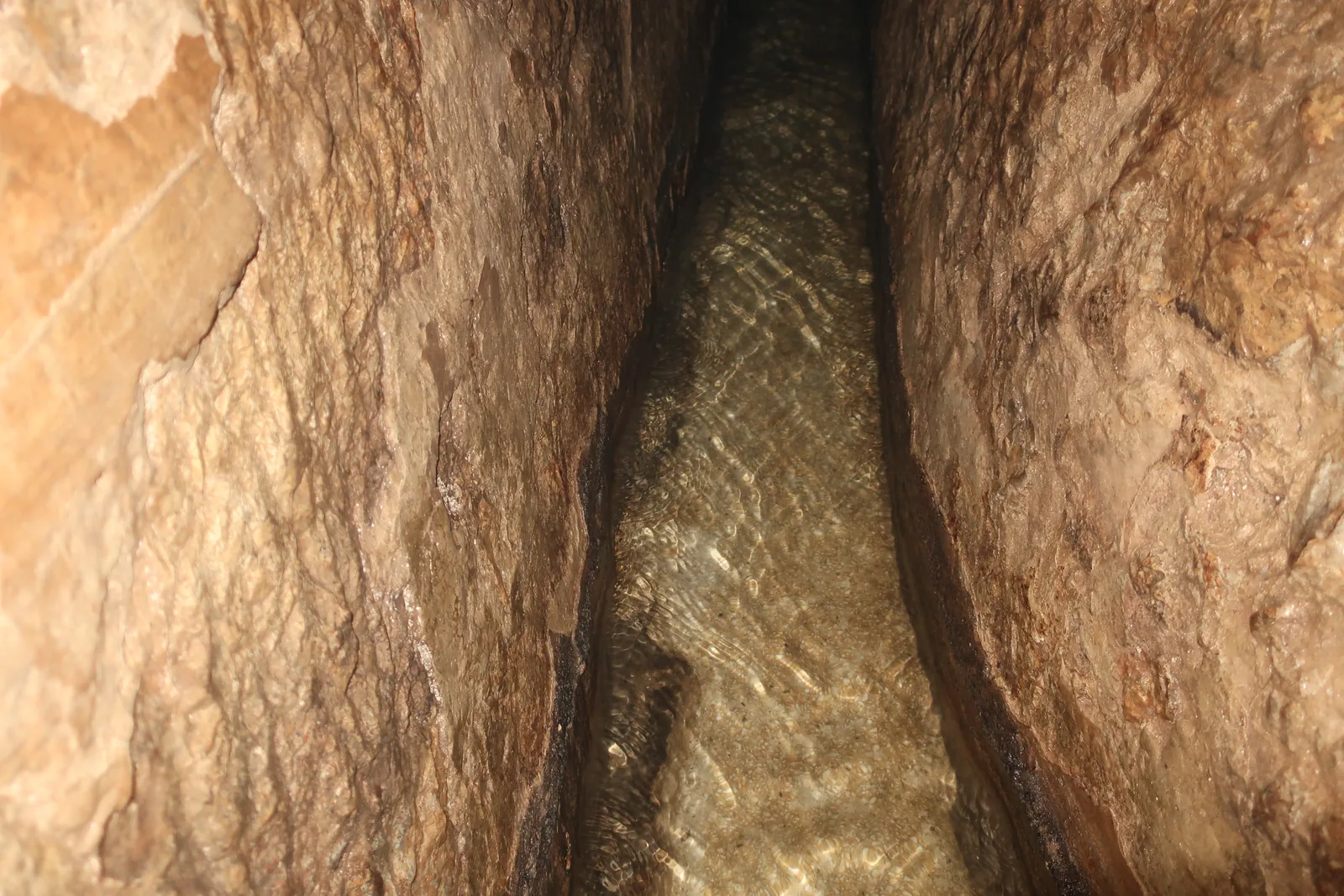
Hezekiah’s Tunnel (the Siloam Tunnel) in Jerusalem, still walkable. 2 Kings 20:20 and 2 Chronicles 32:30 record that Hezekiah cut the conduit.
Photo: Davidbena, via Wikimedia Commons, CC BY-SA 4.0.

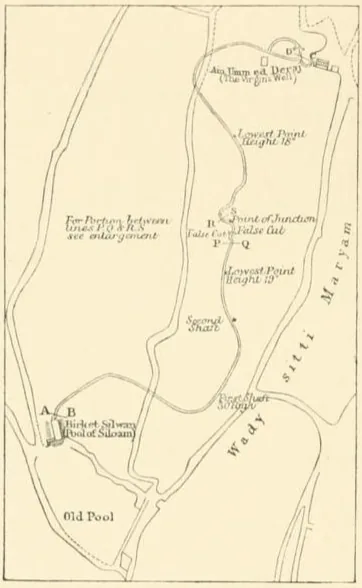
Plan of the Siloam Tunnel from Warren and Conder, The Survey of Western Palestine (1884). The published plan, not a modern reconstruction. Diagram, not to scale; no detail has been added to the 1884 drawing.
Plan: Charles Warren and C. R. Conder, via Wikimedia Commons, Public domain.

The story
Under the City of David in Jerusalem, a tunnel cut through solid rock carries water from the Gihon Spring to the Siloam pool area at the southern end of the ridge. Published figures put its length at about 533 meters; the geologist Aryeh Shimron gives 540. It was dug by two crews working toward each other from opposite ends.[S9][S13][S15][S27]
In 1880 a boy wading in the tunnel noticed letters on the wall a few meters from the southern outlet and told his teacher, Conrad Schick. The Hebrew text tells how, with three cubits still to cut, the crews heard a man calling to his fellow, then struck "axe against axe" until the water flowed 1,200 cubits from the spring to the pool, under 100 cubits of rock.[S11][S10][S9][S8]
The inscription names no king. Gary Rendsburg and William Schniedewind call that unparalleled for a royal building inscription and read the text as celebrating its builders instead. The link to Hezekiah comes from elsewhere: 2 Kings 20:20 credits him with the pool and the conduit that brought water into the city, and 2 Chronicles 32:30 says he brought the Gihon's water down to the west side of the City of David.[S8][S9][S13][S10]
The rest of the case rests on dating. Scholars have long placed the letter forms in the late eighth century BCE. In 2003 Amos Frumkin, Aryeh Shimron and Jeff Rosenbaum reported radiocarbon dates on plant matter in the tunnel's plaster and uranium-thorium dates on stalactites that grew after it was cut. Their university's release put the result at about 700 BCE.[S10][S9][S1][S20][S21]
Not everyone agrees. In 1996 John Rogerson and Philip Davies proposed a Hasmonean date, in the second century BCE. Six scholars answered in Biblical Archaeology Review the next year, and the Nature paper says its dating refutes that claim. From their excavations near the spring, Ronny Reich and Eli Shukron argue the tunnel was finished decades before Hezekiah. Three geologists proposed his son Manasseh instead.[S17][S1][S14][S13]
In 2022 Gershon Galil announced readings of further Hezekiah inscriptions, including lines below the Siloam text. Other researchers questioned them, and they had not been peer reviewed. The stone itself was cut out of the wall and taken by the Ottoman authorities to Istanbul, where it remains. Israel has asked for it several times; Turkey has declined.[S28][S12][S10][S24][S23]
Key findings
| Finding | Sources |
|---|---|
A real tunnel and a real inscriptionThe tunnel still carries Gihon water to the Siloam area, about 533 m by most published figures. The six-line Hebrew inscription found near its southern end in 1880 describes the two crews meeting. The Istanbul Archaeology Museums hold the stone; a copy made before it was cut out is in Jerusalem. | S1 S13 S9 S15 S27 S23 S10 S8 S11 S24 S25 S26 |
The inscription names no kingNo king, god or date appears in the text. 2 Kings 20:20 and 2 Chronicles 32:30 credit the conduit to Hezekiah, and the dating around 700 BCE fits that account. A 2008 fragment from near the spring and Galil's 2022 readings have been put forward as naming Hezekiah, but both readings are disputed and neither is the Siloam text. | S9 S8 S10 S11 S27 S20 S13 S14 S28 S12 S19 |
Dating points to around 700 BCELetter forms place the text in the late eighth century BCE (one reference site says late eighth or seventh). Radiocarbon on the plaster and uranium-thorium on stalactites gave an Iron Age II date, reported as about 700 BCE. Most scholars identify the tunnel with the conduit Scripture credits to Hezekiah. | S10 S9 S27 S20 S17 S1 S21 S22 S13 S8 |
Earlier, later and much later datesReich and Shukron argue from pottery that the tunnel was finished before Hezekiah. Sneh, Shalev and Weinberger proposed Manasseh. Rogerson and Davies' Hasmonean date runs against the radiometric results and was rebutted by six scholars in 1997. | S14 S27 S13 S17 S1 S21 S22 |
How, why and for whom are still arguedWhy the tunnel winds, whether it was dug for the 701 BCE siege or for a growing city, and who the inscription was written for are all debated. The stepped pool found in 2004 is a Second Temple pool, not the Iron Age reservoir. | S15 S13 S27 S8 S14 S11 S18 S10 S16 |
Labels and sources are taken from the linked claims, so they stay in step with the ledger. How we label evidence.
Where scholars land
Conservative
City of David (cityofdavid.org.il)
The City of David site's article holds that the inscription's late eighth-century script shows the tunnel is Hezekiah's work, carrying the Gihon's water to the west of the City of David as 2 Chronicles 32:30 describes. It explains the missing royal name as lost dedication lines or a king honoring his workers.
Critical
Amos Frumkin, Aryeh Shimron and Jeff Rosenbaum (Nature, 2003)
Amos Frumkin, Aryeh Shimron and Jeff Rosenbaum dated plant matter in the tunnel's plaster by radiocarbon and its stalactites by uranium-thorium, placing it in the Iron Age II, about 700 BCE. They conclude the biblical text gives an accurate record of the tunnel's construction. Ronny Reich and Eli Shukron argue it was finished earlier.
Each column states a position in that scholar or institution's own best terms, with a named source.
Records vs. retellings
What people often say
The Siloam inscription names King Hezekiah.
What the object or text actually says
The six lines describe the crews meeting and the water flowing from the spring to the pool. No king, god or date appears.
Where it stands
The Hezekiah link comes from 2 Kings 20:20 and 2 Chronicles 32:30 plus dating. Galil's 2022 claim of further lines naming Hezekiah had not been peer reviewed when reported.
Claims 4–5, 15 ↓What people often say
Carbon dating confirmed that Hezekiah built the tunnel.
What the object or text actually says
The 2003 study dated plant matter in the plaster (about 800 to 510 BC, as Physics World reported it) and stalactites (more than 2,300 years old), and placed the tunnel in the Iron Age II, about 700 BCE.
Where it stands
The dates fit Hezekiah's reign. They do not name the king who ordered the work, and Reich and Shukron argue from pottery that the tunnel was finished earlier.
Claims 6–8 ↓What people often say
The Pool of Siloam where Jesus healed the blind man is Hezekiah's pool.
What the object or text actually says
The stepped pool Reich and Shukron found in 2004 belongs to the Second Temple period. BAS says pools were built at the tunnel's end over the centuries.
Where it stands
John 9:7 points to the Second Temple pool. The reservoir the tunnel first fed is centuries older and is not the 2004 pool.
Claim 17 ↓What people often say
The inscription is on display in Jerusalem.
What the object or text actually says
The original is in the Istanbul Archaeology Museums. The Jerusalem Post says the unbroken copy made before the stone was cut out is displayed at the Israel Museum.
Where it stands
Israel has asked for the original several times and Turkey has declined. Middle East Eye reports it has been moved into storage in Istanbul.
Claims 3, 18 ↓The object
Siloam Tunnel (Hezekiah's Tunnel)
- Name
- Siloam Tunnel (Hezekiah's Tunnel)
- Provenance
- excavated
- Findspot
- In place under the City of David ridge, Jerusalem (Silwan), from the Gihon Spring to the Siloam pool area
- Found
- In place; still carries water
- Holder
- In place (City of David, Jerusalem)
- Catalog
- n/a (a structure in place, not a museum object)
- Peer review
- published
- Announced by
- independent
- Notes
- Not a moved object, so provenance is not in question; 'excavated' is the nearest schema value. The Hebrew University release calls it one of the oldest structures still in use. Length: 533 m (S9, S13, S27), 540 m (S15), about 500 yards (S23). S1 is the radiometric study (abstract read).
- Primary publication
- S1
Siloam inscription (Hebrew tunnel inscription)
- Name
- Siloam inscription (Hebrew tunnel inscription)
- Provenance
- excavated
- Findspot
- Siloam Tunnel wall, about six meters inside the southern outlet (S8); Schick's report, quoted by the City of David site, gives 25 feet from the southern entrance (S11)
- Found
- 1880
- Holder
- Istanbul Archaeology Museums, Istanbul
- Catalog
- Not confirmed: no museum record was opened. A former Turkish museums official gives a registration date of 1883 (S24).
- Peer review
- published
- Announced by
- independent
- Notes
- Found in place by a schoolboy and reported by Conrad Schick (S11), not in a controlled excavation; the findspot is known, so 'excavated' is used. Later cut out of the wall and broken, then recovered by the Ottoman authorities (S10, S11, S27). Sources differ on dates: S11 says it was cut out ten years after discovery; S24 and S25 report an 1883 registration date in Istanbul. Neither the first publication nor an Istanbul museum page was opened; S9 (Albright's translation via Livius) and S8 (IEJ 2010 study) stand in. S24 reports it was moved to storage; S10 says it is on display; S11 says it is not permanently displayed.
- Primary publication
- S9 S8
Bible references
References only. Verse text is not reproduced here.
- 2 Kings 20:20 Credits Hezekiah with making the pool and the conduit that brought water into the city
- 2 Chronicles 32:2-4 Hezekiah and his officers stop the springs outside the city when Sennacherib comes
- 2 Chronicles 32:30 Hezekiah stops the upper outlet of the Gihon and brings the water down to the west side of the City of David
- Isaiah 22:9-11 Mentions the waters of the lower pool and a reservoir made between the two walls
- Isaiah 7:3 Names the conduit of the upper pool, which Maeir and Chadwick cite for a water channel older than Hezekiah
- Isaiah 8:6 Mentions the waters of Shiloah (Siloam), also cited for an earlier water channel
- Sirach 48:17 Deuterocanonical (second century BCE). Says Hezekiah fortified his city, brought water into it and tunneled the rock; likely drawn from Kings and Chronicles
- John 9:7 Cross-link only: the Pool of Siloam of Jesus' time, the Second Temple pool, not the Iron Age reservoir
Timeline
| Date | What happened | Sources |
|---|---|---|
| 701 BCE | Sennacherib besieges Jerusalem but does not take it. | S9 S13 |
| 705-701 BCE | Hezekiah's revolt against Assyria, which Maeir and Chadwick count as four years for building the tunnel. | S13 |
| 715-687 BCE | Hezekiah's reign as given by Livius. Other sources use different dates (Science News: 727-698 BCE). | S9 S22 |
| 835-801 BCE | Reign of Jehoash as dated by BAS. Reich and Shukron's pottery argument would allow the tunnel to go back this far. | S14 |
| 1880 | A schoolboy finds the inscription in the tunnel and tells his teacher, Conrad Schick. | S11 S10 S23 |
| 1883 | Registration date of the inscription at the Istanbul museum, as reported by a former Turkish museums official. The City of David site instead dates the removal from the wall to ten years after the find. | S24 S25 S11 |
| 1996 | Rogerson and Davies propose a Hasmonean date, as later summarized by BAS. The same year, according to the City of David site, Turkey did not answer an Israel Museum request to borrow the stone for Jerusalem's 3,000th anniversary. | S14 S17 S11 |
| 1997 | Biblical Archaeology Review publishes rebuttals of the Hasmonean date. | S17 |
| 1998 | By his own 2025 account, Netanyahu asks Turkish Prime Minister Mesut Yılmaz to return the inscription and is refused. | S24 S25 |
| 2003-09-11 | Frumkin, Shimron and Rosenbaum publish the radiometric dating of the tunnel in Nature. | S1 S21 |
| 2004 | Reich and Shukron uncover the stepped Second Temple Siloam Pool. | S16 |
| 2007 | Jerusalem's mayor asks Turkey's ambassador to return the inscription; a loan was also discussed and did not go ahead. | S23 S24 |
| 2010 | Rendsburg and Schniedewind's study of the inscription appears in the Israel Exploration Journal. | S8 |
| 2011 | BAS summarizes Reich and Shukron's argument that pottery dates allow the tunnel to have been finished earlier than Hezekiah's reign. | S14 |
| 2022-03 | Turkish diplomatic sources deny reports that Turkey will return the inscription after President Herzog's visit. | S26 S27 |
| 2022-12-16 | Gershon Galil announces readings of further Hezekiah inscriptions, including lines below the Siloam inscription. | S28 S12 |
| 2025-09 | Netanyahu recounts his 1998 request; Turkish officials and experts say the stone will stay in Istanbul. | S24 S25 |
| 2026 | Ariel Cohen proposes in Biblical Archaeology Review that the inscription was written for dead workers. | S18 |
Competing explanations
Hezekiah's work, late eighth century BCE
- Case for
- 2 Kings 20:20 and 2 Chronicles 32:30 credit Hezekiah with bringing water into the city (S9, S13). Letter forms place the inscription in the late eighth century (S10, S9), and the radiometric study gave about 700 BCE (S1, S20, S21). Maeir and Chadwick note that the 705-701 BCE revolt allows the four years some geologists estimate for the digging (S13).
- Case against
- The inscription names no king (S8). Radiometric and letter-form dates give a range, not a reign, and Reich and Shukron's pottery points earlier (S14).
- What would settle it
- A securely read royal inscription from the tunnel or the spring, or a tighter stratigraphic date for the tunnel's start, would settle it.
- Sources
- S9 S13 S10 S1 S20 S8 S14
Begun or finished before Hezekiah
- Case for
- Pottery of the late ninth to early eighth century BCE lies in the fill beneath a house that blocked Tunnel IV, which Reich and Shukron take as the tunnel's start (S14).
- Case against
- The radiometric study and the letter forms point to about 700 BCE (S20, S21, S10). Maeir and Chadwick call the earlier date a separate issue that needs discussion (S13).
- What would settle it
- Publication of the full excavation data and a direct date for the link between Tunnel IV and the Siloam Tunnel.
- Sources
- S14 S20 S21 S10 S13
Manasseh, seventh century BCE
- Case for
- Sneh, Shalev and Weinberger estimated the digging took about four years and argued there was not enough time before 701 BCE (S13).
- Case against
- Maeir and Chadwick reply that the revolt gave exactly four years (S13). In replies published by BAS, Aryeh Shimron argues the crews could be guided by sound from the surface (S15).
- What would settle it
- A firmer construction-time estimate and a narrower radiometric range.
- Sources
- S13 S15
Hasmonean, second century BCE
- Case for
- Rogerson and Davies proposed a Hasmonean date in the second century BCE (S14).
- Case against
- Six scholars rebutted it in 1997 (S17), and stalactites more than 2,300 years old rule out a second-century construction according to the Nature study (S1, S21).
- What would settle it
- Largely settled against this view by the radiometric study; no later support was found for this entry.
- Sources
- S14 S17 S1 S21
What would settle it
- A royal inscription from the tunnel or the spring, read and published in a peer-reviewed venue, naming the king who ordered the work.
- An Istanbul Archaeology Museums record would confirm the inventory number, the registration date and whether the stone is on display.
- Peer-reviewed publication of Galil's 2022 readings, and responses to it, would settle the additional-lines row.
What remains unknown
- How long the digging took, and whether it was meant for the 701 BCE siege.
- Who wrote the inscription and for whom.
- When exactly the stone was cut out of the wall and registered in Istanbul (sources give 1883 and about 1890).
- The museum inventory number, which no consulted source gives.
All 18 claims, each labelled and sourced
All 18 claims, each labelled and sourced
| Claim | Evidence | Status | Sources | Checked |
|---|---|---|---|---|
| 1.A rock-cut tunnel under the City of David carries water from the Gihon Spring to the Siloam pool area at the southern end of the ridge. Its length is given as 533 m (Livius; Maeir and Chadwick, reporting Sneh, Shalev and Weinberger; the Jerusalem Post). Shimron gives 540 m; the Associated Press gives around 500 yards. | Confirmed | Broad consensus | S1 S13 S9 S15 S27 S23 | 2026-11-21 |
| 2.A Hebrew inscription found in the tunnel in 1880, a few meters inside the southern outlet, describes two crews digging toward each other. With three cubits left, a man's voice was heard calling to his fellow; the crews struck "axe against axe" and the water flowed from the spring to the pool for 1,200 cubits, with 100 cubits of rock overhead (Albright's translation as given by Livius). | Confirmed | Broad consensus | S9 S10 S8 S11 S23 | 2026-11-21 |
| 3.The inscription was cut out of the tunnel wall, broken in the process, recovered by the Ottoman authorities and taken to Istanbul. The Istanbul Archaeology Museums hold it. A former deputy director of Turkish museums told Middle East Eye its registration date there is 1883, while the City of David site says it was cut out ten years after its discovery; sources therefore disagree on the dates. No museum record or inventory number was consulted for this entry. | Confirmed | Broad consensus | S9 S10 S23 S24 S11 S27 | 2026-11-21 |
| 4.The inscription names no king. Rendsburg and Schniedewind write that it "makes no mention of the king or the deity (or other gods)", which they call unparalleled in royal building inscriptions. COJS, the City of David site, the Jerusalem Post and the Hebrew University's 2003 release all say the same. | Confirmed | Broad consensus | S9 S8 S10 S11 S27 S20 | 2026-11-21 |
| 5.2 Kings 20:20 credits Hezekiah with making the pool and the conduit that brought water into the city, and 2 Chronicles 32:30 says he stopped the upper watercourse of the Gihon and brought it down to the west side of the City of David. 2 Chronicles 32:2-4 places the stopping of the springs before Sennacherib's attack. Sirach 48:17 (deuterocanonical, second century BCE) repeats the tradition, and Rendsburg and Schniedewind judge that its author almost certainly relied on the earlier biblical accounts. | Confirmed | Broad consensus | S9 S13 S8 S14 | 2026-11-21 |
| 6.Frumkin, Shimron and Rosenbaum (Nature, 2003) reported radiocarbon dates on plant material in the tunnel's plaster and uranium-thorium dates on stalactites that grew after it was cut, giving an Iron Age II date. Physics World reported the plaster range as about 800 to 510 BC and the stalactites as more than 2,300 years old; the Hebrew University release and Physics World give about 700 BCE. | Consistent | Majority view | S1 S21 S22 S20 | 2026-11-21 |
| 7.The tunnel is the conduit 2 Kings 20:20 and 2 Chronicles 32:30 credit to Hezekiah. Maeir and Chadwick write that most scholars accept the tunnel was part of Hezekiah's preparations; COJS says it was almost certainly built in his reign; Rendsburg and Schniedewind take the two to be one and the same while noting that no inscription settles it. | Consistent | Majority view | S13 S1 S8 S10 S20 Against: S14 S13 | 2026-11-21 |
| 8.Reich and Shukron argue that the tunnel was completed at least by the early eighth century BCE, before Hezekiah's reign. As BAS summarizes it, pottery in the fill beneath a house that blocked Tunnel IV, which they take as the tunnel's starting point, dates to the late ninth or early eighth century BCE, so the tunnel could go back to Jehoash (835-801 BCE). Reich told the Jerusalem Post he thinks the tunnel took several years and was not dug in response to the Assyrian attack. | n/a | Disputed | S14 S27 | 2026-11-21 |
| 9.Rogerson and Davies (1996) proposed that the inscription, and so the tunnel, is Hasmonean (second century BCE). Most specialists reject this: six scholars rebutted it in Biblical Archaeology Review in 1997, and the Nature paper says its dating "refutes a claim" that the tunnel was built in the second century BC, since the stalactites are more than 2,300 years old. The labels on this row describe the Hasmonean proposal; the majority view is that it does not fit the evidence. | Contradicted | Majority view | S14 S17 S1 S21 S22 | 2026-11-21 |
| 10.Some scholars credit the tunnel to Hezekiah's son Manasseh. Geologists Amihai Sneh, Eyal Shalev and Ram Weinberger argued in BASOR that the tunnel would have taken about four years to dig and proposed a seventh-century date under Manasseh; Maeir and Chadwick reply that the revolt of 705-701 BCE gave Hezekiah exactly four years. | n/a | Disputed | S13 S14 | 2026-11-21 |
| 11.Why the tunnel winds is debated. Sneh, Shalev and Weinberger proposed that it follows natural karstic cavities, as reported by Maeir and Chadwick (S13). In replies published by the Biblical Archaeology Society, Aryeh Shimron argues that the crews could be guided by sound from the surface and that two teams met (S15). | n/a | Disputed | S15 S13 | 2026-11-21 |
| 12.The inscription's letter forms place it in the late eighth century BCE. COJS says the eighth-century date rests on the style of the letters and on grammar and spelling; Livius gives "the late eighth or seventh century"; Reich told the Jerusalem Post the letter shapes give the tunnel a date. Before 2003 the Hezekiah dating rested on the biblical text and the inscription's characteristics, according to the Hebrew University release. | Consistent | Majority view | S10 S9 S27 S20 S17 | 2026-11-21 |
| 13.Whether the tunnel was dug to prepare for Sennacherib's attack of 701 BCE is debated. 2 Chronicles 32:2-4 links the stopping of the springs to his coming; Maeir and Chadwick place the work in the four years of revolt; Shimron reads the two-team method as a hurried effort. Reich argues it took years and could not have been a response to the attack, and Rendsburg and Schniedewind think it was most likely built to bring water to the growing population on the Western Hill. | n/a | Disputed | S13 S15 S27 S8 S14 | 2026-11-21 |
| 14.Who the inscription was written for is debated, since it sat about six meters inside a water tunnel where few would see it. The City of David site reads it as a royal inscription; Rendsburg and Schniedewind say it is not a royal display inscription and was written by someone among the builders, in a non-Judahite variety of Hebrew; Ariel Cohen (Biblical Archaeology Review, 2026) suggests it was a message for workers who died during the project. | n/a | Disputed | S11 S8 S18 S10 | 2026-11-21 |
| 15.In December 2022 Gershon Galil announced that he had read five further royal inscriptions of Hezekiah in the City of David, and claimed that five more lines lie below the place where the Siloam inscription was cut out. The Jerusalem Post reported that the findings had been questioned by other researchers and had not been validated or peer reviewed; ABR advised waiting for the academic community to evaluate claims made so far in a Facebook post and media reports. | No direct evidence | Disputed | S28 S12 | 2026-11-21 |
| 16.A separate, broken inscribed stone found near the Gihon Spring and published by Reich and Shukron in 2008 has been restored by some scholars to read "Hezekiah made the pool". Rendsburg and Schniedewind say it may lend support to the Hezekiah attribution if that restoration is correct; Christopher Rollston objects that much of the name is restored, and Pieter van der Veen defends the reading. It is not the Siloam inscription. | n/a | Disputed | S8 S19 | 2026-11-21 |
| 17.The stepped Siloam Pool that Reich and Shukron found in 2004 dates to the Second Temple period and is the pool of Jesus' time (John 9:7). BAS says the site's history reaches back to Hezekiah and that different pools were built here over the centuries. The 2004 pool should not be confused with the Iron Age reservoir the tunnel first fed. | Consistent | Majority view | S16 | 2026-11-21 |
| 18.Israeli officials have asked Turkey for the inscription several times: Prime Minister Netanyahu asked Mesut Yılmaz in 1998 (by Netanyahu's own 2025 account), Jerusalem's mayor asked in 2007, and Israeli officials raised it again in 2022. Turkey has declined, saying the stone was lawfully registered in Istanbul under Ottoman rule, and in 2022 Turkish diplomatic sources denied reports that it would be returned. | n/a | Broad consensus | S23 S24 S25 S26 S27 | 2026-11-21 |
Evidence: what the object, inscription or text supports. A Documented record tag marks a purchase, edition, test, retraction or disclosure. Status: how far specialists agree. How we label evidence.
Sources
- S1Amos Frumkin, Aryeh Shimron and Jeff Rosenbaum, “Radiometric dating of the Siloam Tunnel, Jerusalem”, Nature 425, pp. 169-171, 2003-09-11.peer-reviewedTier 1critical Link · accessed 2026-11-21
Note: Publisher page and abstract read; the full text is paywalled. The abstract reports radiocarbon and U-Th dating, an Iron Age II date, and that the dating refutes a second-century BC claim. - S8Gary A. Rendsburg and William M. Schniedewind, “The Siloam Tunnel Inscription: Historical and Linguistic Perspectives”, Israel Exploration Journal 60 (2010), pp. 188-203, 2010.peer-reviewedTier 1neutral Link · accessed 2026-11-21
Note: Author's PDF on Rendsburg's Rutgers faculty page, read in full via a local text extraction. The plan's attempt returned 500; it loaded this run. - S9Jona Lendering (translation W. F. Albright), “The Siloam Inscription”, Livius.org (ANET 321), 2012; last modified 2020-10-04.edition/translationTier 2neutral Link · accessed 2026-11-21
Note: Reference site giving Albright's translation from ANET, plus a note on the tunnel (533 m) and the museum in Istanbul. Used as the opened translation; the ANET volume itself is cited from later reports. - S10Center for Online Judaic Studies, “Hezekiah's (or Siloam) Tunnel Inscription, 701 BCE”, Center for Online Judaic Studies (COJS), undated web page.institutionalTier 2neutral Link · accessed 2026-11-21
Note: Gives a translation, the find in 1880, the Ottoman confiscation, the Istanbul location, and the statement that the inscription does not refer to King Hezekiah. - S11City of David (cityofdavid.org.il), “The Siloam Inscription”, City of David (English site), 2023-09-14 (modified 2025-01-27).advocacyTier 3conservative Link · accessed 2026-11-21
Note: Site of the City of David tourist attraction; Middle East Eye (S24) describes the site as operated by the Elad settler organisation. Quotes Conrad Schick's account of the find. The author is named in Hebrew script in the page metadata and is not transliterated here. - S12Associates for Biblical Research, “Scholar Announces Discovery Of Multiple Royal Inscriptions Of King Hezekiah”, Associates for Biblical Research, 2022-12-22.advocacyTier 3conservative Link · accessed 2026-11-21
Note: News note; no individual byline shown. Advises caution because the claims had been made only in a Facebook post and media reports. - S13Aren M. Maeir and Jeffrey R. Chadwick, “Regarding Recent Suggestions Redating the Siloam Tunnel”, Biblical Archaeology Society, Bible History Daily, 2013-08-26.secondaryTier 2critical Link · accessed 2026-11-21
Note: Page metadata credits BAS Staff; the text ends with author notes for Maeir and Chadwick, so it is attributed to them. Reports Sneh, Shalev and Weinberger's BASOR proposal (533 m, about four years, Manasseh). - S14BAS Staff, “Hezekiah's Tunnel Reexamined”, Biblical Archaeology Society, Bible History Daily, 2026-06-16 (republished; first posted 2013).secondaryTier 2neutral Link · accessed 2026-11-21
Note: Summarizes Hershel Shanks's BAR article (Sept/Oct 2013), Rogerson and Davies' Hasmonean date, and Reich and Shukron's Tunnel IV pottery argument. Reader comments on the page were not used. The 2013 first-post date is from a search snippet; the page metadata shows 2026-06-16. - S15Biblical Archaeology Society Staff (with responses by Aryeh Shimron), “Hezekiah's Tunnel Revisited”, Biblical Archaeology Society, Bible History Daily, 2012-07-12.secondaryTier 2critical Link · accessed 2026-11-21
Note: Reader letters with Shimron's replies; only Shimron's replies are used (540 m length, acoustic guidance, two-team method). - S16BAS Staff, “The Siloam Pool: Where Jesus Healed the Blind Man”, Biblical Archaeology Society, Bible History Daily, 2026-06-11 (based on BAR, July/Aug-Sept/Oct 2009).secondaryTier 2neutral Link · accessed 2026-11-21
- S17Jo Ann Hackett, P. Kyle McCarter, Ada Yardeni, André Lemaire, Esther Eshel and Avi Hurvitz, “Defusing Pseudo-Scholarship: The Siloam Inscription Ain't Hasmonean”, Biblical Archaeology Review 23.2 (March/April 1997), pp. 41-51, 68, 1997-03.secondaryTier 2critical Link · accessed 2026-11-21
Note: BAS Library page opened via The page (a request got an access error); only the introduction is public, and it does not show the authors. Authors, title and pages are from the reference lists of S8 and S1. Its arguments are not quoted beyond the introduction. - S18Lauren K. McCormick, “Was the Siloam Inscription a Message for the Dead?”, Biblical Archaeology Society, Bible History Daily, 2026-05-20.secondaryTier 2neutral Link · accessed 2026-11-21
Note: Summarizes Ariel Cohen's Spring 2026 BAR article, which is cited from later reports. - S19Pieter Gert van der Veen, “Too Good to Be True? Not Necessarily So!”, Biblical Archaeology Society, Bible History Daily, 2025-11-03.secondaryTier 2neutral Link · accessed 2026-11-21
Note: Responds to Christopher Rollston's BAR article (cited from later reports); quotes Rollston's objection to the 2008 fragment's restoration. - S20Hebrew University of Jerusalem, “Dating of King Hezekiah's Tunnel verified by scientists”, EurekAlert! (AAAS), 2003-09-10.institutionalTier 2critical Link · accessed 2026-11-21
Note: Press release from the lead author's university, so not independent of S1. - S21Isabelle Dumé, “Carbon dating confirms origins of biblical tunnel”, Physics World, 2003-09-10.secondaryTier 2neutral Link · accessed 2026-11-21
- S22Bruce Bower, “Ancient tunnel keeps biblical date”, Science News, 2003-09-29.secondaryTier 2neutral Link · accessed 2026-11-21
- S23Associated Press, “Jerusalem Mayor Wants Ancient Tablet Back”, CBS News (AP), 2007-07-13.secondaryTier 2neutral Link · accessed 2026-11-21
- S24Ragip Soylu, “How an ancient Jewish inscription became a flashpoint between Turkey and Israel”, Middle East Eye, 2025-09-17.secondaryTier 2neutral Link · accessed 2026-11-21
- S25Hürriyet Daily News, “Experts dismiss Netanyahu's claim over Siloam Inscription”, Hürriyet Daily News, 2025-09-18.secondaryTier 2neutral Link · accessed 2026-11-21
- S26Daily Sabah, “Turkey denies return of inscription to Israel after Herzog visit”, Daily Sabah, 2022-03-13.secondaryTier 2neutral Link · accessed 2026-11-21
- S27Judith Sudilovsky, “Famous Siloam Inscription shows the complexity of repatriation of antiquities”, The Jerusalem Post, 2022-03-18.secondaryTier 2neutral Link · accessed 2026-11-21
Note: Quotes Ronny Reich and Aren Maeir. Gives the tunnel as 533 m and says the inscription names no king or date. - S28Judy Siegel-Itzkovich, “Detailed inscriptions of 8th-century BCE Judean King Hezekiah discovered in 'monumental' archaeological discovery”, The Jerusalem Post, 2022-12-16.secondaryTier 2neutral Link · accessed 2026-11-21
Note: Reports Galil's claims and states they had been questioned by other researchers and not validated or peer reviewed.
Tier 1 is a primary record: a museum record, excavation report, edition or peer-reviewed paper. Tier 3 sources are cited as the views of those organizations. How we label evidence.
Evidence log
- The inscription was found in the tunnel and reported by Conrad Schick (S11, S10).
- Rogerson and Davies proposed a Hasmonean date (as summarized in S14).
- Six scholars rebutted the Hasmonean date in BAR (S17).
- Radiometric dating placed the tunnel in the Iron Age II, about 700 BCE (S1, S20, S21).
- Rendsburg and Schniedewind argued the inscription is not a royal display text and reflects a northern variety of Hebrew (S8).
- Reich and Shukron argued for completion before Hezekiah, as summarized by BAS (S14).
- Galil announced readings of further Hezekiah inscriptions; reported as not peer reviewed (S28, S12).
- Cohen's reading of the inscription as a message for dead workers was reported (S18).
- Entry first written.
- Scripture policy: dropped the Rogerson and Davies column that denied Hezekiah's role; rewrote dek, verdict and unknowns so the biblical attribution is treated as true, with the stone's silence on the king's name stated without doubt.
- update Sources list tightened: each claim now cites only sources we opened and checked, and a few sentences we couldn't check were removed.